
GDPR for Etsy Sellers: Handling Customer Data the Right Way

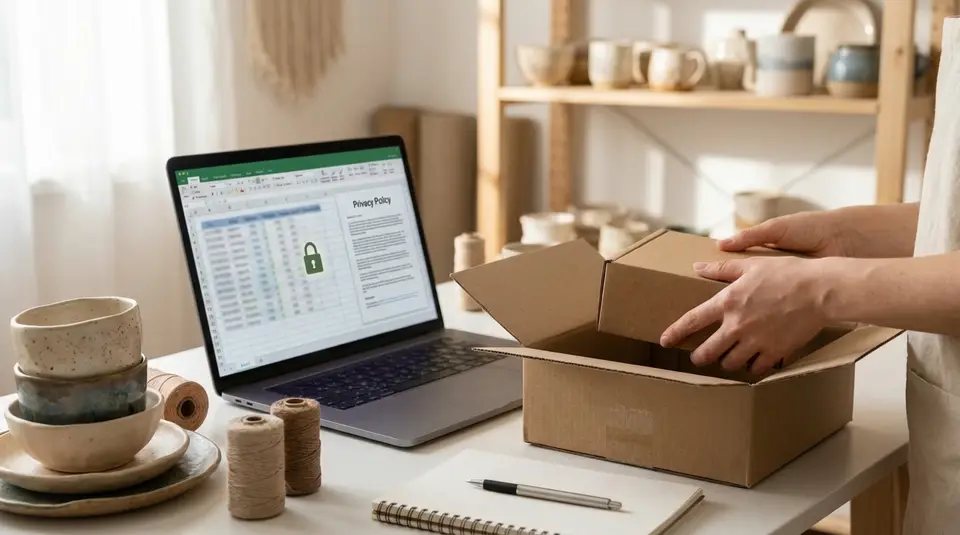
GDPR sets clear rules for how you collect, use, store, and share customer personal data when selling to people in the EU and EEA. For Etsy sellers, that usually means treating names, addresses, emails, order notes, and any customization details as information you handle on purpose, not casually. The basics are simple: only use data for specific reasons you can explain, keep a plain-language privacy policy that matches what you actually do, limit access and retention, and be ready to respond if a buyer asks for access or deletion. The most common slip-up is exporting buyer info for shipping, email, or bookkeeping and then forgetting it exists.
GDPR basics for Etsy sellers: roles, scope, and responsibilities
Data controller vs processor on Etsy
In plain English, the data controller is the party deciding “why” and “how” personal data is used. A processor handles data only on someone else’s instructions.
For most Etsy shops, you act as a data controller for the customer information you use to run your business. That includes using a buyer’s name, address, and order details to fulfill an order, answer messages, handle returns, and keep required records.
Etsy also collects and uses personal data to operate the marketplace, process payments, prevent fraud, and run core platform features. That means Etsy has its own data responsibilities too, separate from yours. Your job is to be clear about what you do with buyer data and to keep your actual practices aligned with your written policy, especially if you export data outside Etsy (like to shipping software, accounting tools, or an email list). Etsy outlines seller-facing GDPR expectations in its Help Center guidance on How to Comply with General Data Protection Regulation.
When GDPR applies to your shop
GDPR can apply to you in two common situations:
- You are based in the EU/EEA (or the UK, under UK GDPR). If you run your shop from these regions, the rules typically apply to your customer data handling.
- You sell to buyers in the EU/EEA. If your shop offers goods to people there, GDPR can still matter even if you live elsewhere.
A practical way to think about scope is this: if you can receive orders from EU/EEA customers, assume you need GDPR-ready habits. That means a shop privacy policy, a reason for each use of data, careful handling of data outside Etsy, and a simple plan for responding to buyer requests.
Etsy shop privacy policy essentials you need to publish
Required sections buyers expect to see
A good Etsy privacy policy is short, specific, and matches how you actually run orders. Buyers mainly want to know what you collect, why, and who else sees it.
At minimum, your Etsy shop privacy policy should clearly cover:
- What personal data you collect: name, email address, shipping address, order details, and any personalization details a buyer types in.
- Why you need it: order fulfillment, customer support, custom work, legal and tax recordkeeping, and resolving disputes.
- Where the data comes from: Etsy checkout, Etsy Messages, and any off-Etsy forms you use (if applicable).
- Who you share it with: Etsy, shipping carriers, print or production partners, and any tools you use to run your shop (only if you actually use them).
- How long you keep it: a simple retention window tied to taxes, accounting, and support needs.
- How buyers can contact you: a reliable email address, plus what to do if they want access or deletion.
- International transfers (if relevant): if you are outside the EU/EEA or use tools that store data elsewhere, say so in plain language.
Ready-to-publish Etsy privacy policy template
Use this as a starting point, then edit it to be truthful for your shop. Etsy also provides a detailed sample you can adapt in How to Write On-Point Privacy Policies.
Privacy Policy
I, [YOUR NAME/BUSINESS NAME], am the data controller of your personal information for the purposes of EU data protection law.
What information I collect
To fulfill your order, you provide me with certain information (such as your name, email address, postal address, payment information, and the details of the product that you’re ordering). You may also choose to provide me with additional personal information (for a custom order, for example), if you contact me directly.
Why I need your information and how I use it
I rely on a number of legal bases to collect, use, and share your information, including: to provide my services (processing your order, shipping it, and providing customer support); when I have a legal obligation (like tax and accounting); and when necessary for my legitimate interests (improving my services), as long as those interests aren’t overridden by your rights.
Sharing and disclosure
I share your information for limited reasons, such as: Etsy (to provide my services and comply with Etsy’s policies), shipping providers (to deliver your order), and other service providers I use to run my shop (only as needed).
Data retention
I keep your personal information only for as long as necessary to provide my services and as described in my policy.
Your rights
If you reside in the EU/EEA, you may have rights to access, change, restrict, or delete your personal information. If you need help with data held by Etsy, you can contact Etsy directly.
How to contact me
For privacy-related questions, you can contact me at [EMAIL], or mail me at [ADDRESS].
Fill-in fields for your shop details
Replace these placeholders before publishing:
- [YOUR NAME/BUSINESS NAME] (and whether you use “I” or “we”)
- [EMAIL] you check regularly for privacy requests
- [ADDRESS] for formal contact (use your business address if you have one)
- Your real retention period (example: “kept for X years for tax records”)
- Your actual third parties (example: specific shipping carriers, production partners, bookkeeping tools)
- Any marketing use of buyer info outside Etsy (newsletter, email list, abandoned cart flows), or state plainly that you do not use buyer data for off-Etsy marketing
Personal data you collect from Etsy buyers and why
Order, payment, and delivery information
The most common personal data you handle on Etsy is the information needed to complete an order. Think: buyer name, delivery address, and details about what they bought. You may also see buyer contact details such as an email address, depending on how the transaction and your shop settings appear in your order view.
Payment is a special case. Etsy runs the checkout and payment flow, so your day-to-day need is usually “is this order paid” and “what do I need to ship,” not a buyer’s full payment credentials. As a seller, you should avoid collecting or storing extra payment info off-platform. Etsy’s Seller Policy is explicit that buyer information you receive through Etsy is for Etsy-related communications and transactions, and you generally shouldn’t retain payment information. You can review this in Etsy’s Seller Policy.
Messages, custom orders, and personalizations
Etsy Messages and custom work can quickly turn “basic order data” into more sensitive personal data.
Common examples include:
- Custom text (names, dates, locations).
- Photos a buyer sends (family pictures, pet images, logos).
- Special delivery notes (gate codes, workplace instructions, travel dates).
- Health-related details (for example, allergy notes for certain product types).
Only ask for what you truly need to make the item or deliver it correctly. If a buyer shares extra details, do not reuse them for any other purpose.
Your legal bases for processing
For most Etsy sellers, the practical legal bases map like this:
- Contract: processing is needed to fulfill the order, ship it, and provide support.
- Legal obligation: keeping records you must retain for tax and accounting.
- Legitimate interests: basic shop operations like fraud prevention, quality control, and improving listings, as long as it’s balanced and reasonable.
- Consent: anything marketing-related outside Etsy (like adding someone to an email list) generally needs an opt-in.
Who you share customer data with (Etsy, shipping, tools)
Common third parties and service providers
Even if you never “sell” customer data, you still share it to get orders out the door. Under GDPR, the key is to share only what’s necessary, and to be honest about it in your Etsy privacy policy.
Common parties that may receive buyer personal data include:
- Etsy (marketplace operations, order management, payments, trust and safety).
- Shipping carriers and postal services (name, address, and sometimes phone number if required for delivery).
- Production partners (for example, print or manufacturing partners you use to create the item). Share the minimum details needed to produce and ship.
- Business tools you choose outside Etsy, such as shipping label services, bookkeeping/accounting software, customer support tools, or cloud storage where you save order files.
- Professional advisors (accountant, tax preparer, lawyer) when necessary for legitimate business needs.
A practical habit: keep a simple “vendor list” for your shop. Note what each service is, what data you send, and why. If you stop using a tool, stop exporting data to it and clean up old exports when you can.
Handling third-party breaches and notifications
If a third party you use has a breach, treat it as your problem to manage, not just theirs. Under GDPR, controllers generally must notify the relevant supervisory authority within 72 hours of becoming aware of a notifiable personal data breach, unless it’s unlikely to pose risk to people’s rights and freedoms. Processors are expected to notify the controller without undue delay.
For Etsy sellers, the most realistic plan is:
- Confirm what happened and what data was involved (names, addresses, message content, personalization files).
- Contain the issue (revoke access, reset passwords, disable app integrations, rotate API keys).
- Document everything: timeline, systems affected, and what you changed.
- Decide who must be notified: Etsy (if Etsy-related data or accounts are involved), any affected buyers (if there’s likely high risk), and regulators when required.
When in doubt, get professional legal advice for your specific country and customer base.
Data retention: how long to keep order records and messages
Storage, security, and access controls
GDPR’s “storage limitation” principle is simple: keep personal data only as long as you truly need it. For Etsy sellers, the main reasons to keep order records are customer support, refunds and chargebacks, and tax or accounting rules.
Instead of picking a random number, set a retention period that matches your reality. Many sellers keep order and accounting records for several years because local tax authorities often require it. Your exact timeline depends on where you are based and how you file taxes, so write your policy in a way you can defend and follow.
Security matters just as much as the timeline. Good baseline controls for small Etsy shops include:
- Use a strong, unique password for Etsy and email, plus two-factor authentication.
- Limit who can access order exports, customer messages, and personalization files.
- Store downloads (CSV exports, shipping files, custom images) in a secured location, not in a shared family computer folder.
- Be careful with printing packing slips. Shred or black out names and addresses before disposal.
Deletion and anonymization in practice
Retention gets messy when personal data spreads across places: Etsy order history, shipping labels, email threads, downloaded message attachments, and folders for custom designs.
A practical approach is to set a regular cleanup routine:
- Stop creating new copies you do not need. If Etsy already holds the order details, avoid exporting unless there’s a clear business reason.
- Delete old exports after your retention period ends (order spreadsheets, label PDFs, photo attachments).
- Anonymize when you can: keep sales totals and product SKUs for analytics, but remove names, addresses, and message content.
- Check your tools: if you use cloud storage, label software, or bookkeeping apps, make sure you know how to delete data there too.
If a buyer asks you to delete data, remember that deletion is not always immediate or total if you must keep certain records for legal or tax obligations. The key is to delete what you can, and explain clearly what you must retain and why.
Buyer GDPR rights: access, deletion, and objections
Receiving and verifying a rights request
GDPR gives buyers rights over their personal data, including the right to access what you have, request deletion in certain cases, and object to specific uses (especially marketing).
In practice, rights requests usually arrive as a normal message, not a formal “GDPR request.” A buyer might say, “What info do you have on me?” or “Please delete my details.” Treat those as valid requests and handle them calmly.
Your job is to (1) understand what they’re asking for, (2) verify you’re dealing with the right person, and (3) respond on time. Under GDPR, you typically need to respond without undue delay and generally within one month, and you can ask for extra information to confirm identity when it’s reasonable, which the European Commission summarizes clearly in its guidance on dealing with requests from individuals exercising their data protection rights.
Verification should be proportionate. If the request comes through the Etsy account that placed the order, that may be enough. If it comes from a different email or includes a different name, pause and confirm order details before sharing anything.
Responding when data lives in Etsy systems
Here’s the key Etsy-specific point: you can only control what you control.
If the data is in your own systems (order exports, shipping label PDFs, personalization files, email threads), you can usually provide a copy, delete files you no longer need, and stop non-essential uses.
If the data is primarily inside Etsy’s systems, you may need to direct the buyer to Etsy for platform-level access or deletion. You should still help by explaining what you personally have stored outside Etsy and what you can remove. Etsy’s seller-facing overview is in How to Comply with General Data Protection Regulation.
Marketing and customer communications that stay GDPR-compliant
Etsy messages vs email lists and newsletters
For GDPR, the safest communication channel is usually Etsy Messages, because it stays tied to the transaction and keeps your buyer’s data inside the platform.
Email lists and newsletters are different. The moment you copy a buyer’s email address into Mailchimp, Klaviyo, or any other system, you’re doing separate marketing processing. That raises your responsibilities fast: you need a clear purpose, a legal basis, a retention plan, and an easy way to opt out.
Etsy’s rules also matter here. Etsy is very clear that buyer information you receive from an order is for Etsy-related communications and Etsy-facilitated transactions, and you can’t use it for unsolicited marketing. The policy language is in Etsy’s Seller Policy.
If you want a newsletter, build it the clean way: invite people to opt in, make it obvious what they’re signing up for, and do not auto-add purchasers just because you have their details.
Consent, opt-outs, and review requests
For most Etsy shops, here’s the practical rule:
- Transactional messages (shipping updates, address questions, customization clarifications, issue resolution) are fine. Keep them focused on the order.
- Marketing messages (new product drops, sales, “follow me on social,” newsletter promos) should be sent only when you have a valid opt-in for that channel.
If you collect consent, make it specific. “Yes, email me your newsletter” is different from “email me about my order.” And once someone opts out, honor it quickly and permanently.
Review requests can be tricky. A simple, neutral post-delivery note like “If you have a moment, an Etsy review helps my small shop” is generally safer than repeated nudges, incentives, or anything that pressures a buyer. Avoid “review gating” (only asking happy customers) and avoid including extra personal data in follow-ups.
Related posts
Keep reading
Best Packaging Supplies for Etsy Sellers
Discover budget-friendly, eco-friendly Etsy packaging supplies—cute mailers, custom boxes, tissue, stickers, and inserts that protect products and delight buyers.
Dimensional Weight: What Etsy Sellers Need to Know
Learn how dimensional weight affects Etsy shipping costs, packaging, and pricing so you protect profits, reduce fees, and delight customers on every order.

Holiday Shipping Deadlines for Etsy Sellers (Planning Guide)
Holiday shipping deadlines guide for Etsy sellers with USPS, UPS, FedEx cutoff dates, processing times, packaging tips, and planning strategies to avoid late deliveries.

What Is a 1099-K? What Etsy Sellers Need to Know
1099-K for Etsy sellers: when you’ll get one, what counts as gross sales, and how to reconcile totals with shop records at tax time, and state limits.

How to Deal With Difficult Customers on Etsy Without Losing Reviews
Difficult customers on Etsy: use calm message templates, clear refund or replacement options, and smart review responses that protect ratings and policies.

Selling Mugs on Etsy: Dishwasher/Microwave Claims Without Risky Promises
Selling mugs on Etsy: Practical wording for dishwasher-safe and microwave-safe claims, plus care notes and limits to match your materials without overpromising.