
How to Collaborate With Creators to Promote Your Etsy Shop (Outreach Script)

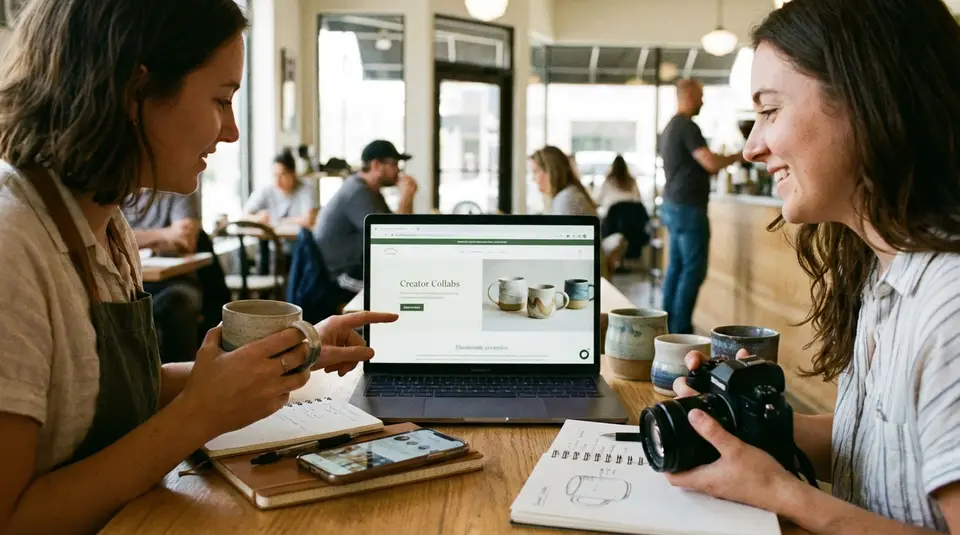
Creator outreach is one of the quickest ways to get your Etsy shop noticed through creators whose audience already loves the style, problem, or hobby your products fit. Done well, it is simply a respectful partnership pitch: a specific compliment that proves you know their content, a clear offer (gifted product, paid post, or commission via an affiliate link or discount code), and one easy yes-or-no next step. The best messages also remove friction by naming the exact item, shipping details, a simple timeline, and what content you are hoping for without micromanaging. The surprising part is how often great products get ignored because the first line sounds like a copy-paste ad.
Creator collaborations for Etsy shops: when they make sense
Goals that pair well with creator promos
Creator collaborations make the most sense when you want demand you can feel fast: more eyes on a specific listing, more favorites, more shop visits, and a clear story around why your item is worth buying. They are especially useful for launches (new product, new collection), seasonal pushes (Mother’s Day, weddings, holiday gifting), and “hard to explain in photos” products like personalized items, size-sensitive products, or anything that benefits from a quick demo.
They can also support longer-term goals like building your brand style and social proof. A creator’s video can show packaging, materials, and real-life use in a way a listing gallery cannot. Pair that with a simple Etsy coupon code or a dedicated featured listing and you have a clean way to measure interest. Etsy’s own guidance on marketing and promotions can help you tighten the rest of your funnel before you send traffic. You can browse the Seller Handbook marketing and promotions hub for ideas that complement creator promos.
Common collaboration formats for handmade products
The best formats are the ones that match your margins and your production pace. For Etsy sellers, that usually looks like a gifted product in exchange for content, a paid post with clear deliverables, or an affiliate-style arrangement using a trackable link and/or coupon code.
Short-form video tends to work well for handmade products: unboxing, “before and after,” styling, and quick how-it’s-made moments. For personalized items, a “customer journey” format converts: choosing options, approving a proof, then revealing the finished piece. If you sell higher-priced work, micro-creators can outperform big accounts because their audiences often trust them more.
Red flags that waste time or hurt your brand
Watch for creators who cannot show basic audience fit, dodge questions about deliverables, or insist on vague promises like “it will go viral.” Another red flag is misaligned expectations: you need a two-week turnaround, but they post whenever they feel like it. Protect your shop operations too. If a creator pushes you to rush production, ignore your processing times, or promise delivery dates you cannot control, the collaboration can quickly turn into customer service headaches.
Finally, avoid partnerships that make disclosure awkward. If a creator refuses to label gifted or paid content clearly, it puts both of you at risk and can damage trust with shoppers.
Finding creators who fit your Etsy niche and style
Where to source creators beyond big platforms
If you only search TikTok and Instagram, you will miss creators who are a perfect match for Etsy style products but do not chase trends. Start closer to your category. Search Etsy itself for similar items and look at shopper photos and review images. Many buyers are creators, or they will tag creators when gifting.
Next, look for creators where your product naturally belongs:
- YouTube channels in your niche (craft, home decor, stationery, cosplay, wedding planning, teachers, new parents).
- Pinterest creators who consistently pin in your keyword clusters.
- Substack newsletters and hobby blogs where the audience is small but highly ready-to-buy.
- Community spaces: Reddit niche subs, Facebook Groups, Discord servers, and forums. Use these to discover names, then pitch off-platform.
- Local creators via craft fairs, maker markets, and small boutiques. A local collab can be easier to ship and easier to film.
Also check your own customers. Repeat buyers, social tags, and “favorites” can surface people who already like your work.
Vetting audience fit, content quality, and vibe
Audience fit is more important than follower count. Scan recent posts and ask: do commenters match your buyer? Do they ask buying questions, or only react with memes? Look for signs the creator can sell handmade: close-ups, clear lighting, texture shots, and a willingness to explain why something costs what it costs.
Vibe matters too. Your shop has a tone, whether it is cozy, minimalist, bold, quirky, or luxury. Pick creators whose voice matches that tone so the content feels natural, not like an ad read.
Shortlist scoring: reach, relevance, reliability
Keep your shortlist simple so you can move fast. Give each creator a 1 to 5 score in three buckets:
- Reach: average views, not just follower count.
- Relevance: how often they feature items like yours and how “buy-ready” the comments feel.
- Reliability: consistent posting, clear contact info, and past brand collabs that look well executed.
A creator with moderate reach but high relevance and reliability is usually the safest first Etsy collaboration.
Outreach messages creators reply to (DM and email scripts)
Subject lines and pitch hooks for Etsy items
Good outreach feels personal, specific, and easy to answer. Your goal is not to “sell” the creator. It is to offer a clean collaboration idea that fits their content and respects their time.
Subject line ideas for Etsy collabs:
- Collab idea for your [series name]: [Product] from my Etsy shop
- Gifted [product] for a quick try-on or unboxing?
- Paid UGC request: [product] demo video (Etsy seller)
- Your [recent post topic] made me think of this [product type]
- Can I send you a [product] for a [platform] video?
Pitch hooks that work well for handmade and personalized items:
- Call out a specific post and why your product fits that exact vibe.
- Lead with the product and what makes it different (material, process, personalization, problem solved).
- Offer a simple collaboration option (gifted, paid, or commission) instead of making them guess.
- Make fulfillment feel safe: where you ship from, typical processing time, and whether it is made-to-order.
Cold DM script with placeholders
Hi [Name]! I’m [Your name], the owner of [Shop name] on Etsy. I loved your [specific video/post] about [specific detail]. Your style is exactly what I think buyers of [product category] look for.
I make [product name] (Etsy link: [listing link]) and the key details are: [material], [size/fit], and [personalization option if any]. I’d love to collaborate if you’re open to it.
Would you be interested in either:
- Gifted: I send you [product] and you share a [Reel/TikTok/Story/PIN] if you genuinely like it, or
- Paid/UGC: [deliverable, ex: 1 TikTok + 3 raw clips] for $[budget], with permission to repost on my shop socials?
If yes, I can send color/size options and a quick timeline. What’s the best email to use for details?
Cold email script with placeholders
Subject: [Collab idea] [Product] for your [audience/niche] (Etsy shop)
Hi [Name],
I’m [Your name], and I run [Shop name], an Etsy shop that makes [short product category description]. I’ve been following your content since [specific reference], and your recent [post/video] on [topic] was spot on, especially the part about [specific detail].
I think your audience would genuinely like my [product name], because it’s [1-2 differentiators: material, function, personalization, use case]. Here’s the listing: [listing link].
Collab options (your pick):
- Gifted product in exchange for [1 short-form video OR 1 post + 1 story], posted by [date range].
- Paid partnership: [deliverables] for $[budget].
- Affiliate-style: a unique coupon code like [CREATORCODE] plus a commission per sale if that’s a better fit.
Logistics: I ship from [location], typical processing time is [X] business days, and this item is [ready-to-ship/made-to-order]. If you’re open to it, I can send a simple one-page agreement covering deliverables, usage rights, and disclosure.
Are you interested? If yes, tell me which option you prefer and your shipping address (or any P.O. box policy you use).
Thanks,
[Your name]
[Shop name] (Etsy)
[Instagram/TikTok]
[Email]
Follow-up and negotiation messages that keep it friendly
Follow-up sequence scripts that don’t feel spammy
Most creators miss messages. A calm follow-up is normal. Keep it short, assume good intent, and always make the next step easy.
Follow-up #1 (2 to 3 business days later)
Hi [Name]! Quick bump on my collab note about [product]. No rush at all. If you’d like, I can send over color options and the two collab choices (gifted vs paid) in one message. Interested?
Follow-up #2 (about 7 days after the first message)
Hi [Name], circling back once more. I think [product] would fit your [series/topic] really well, especially because [one specific reason]. If you’re not taking collabs right now, totally fine, just let me know and I’ll close the loop.
Last follow-up (about 14 days after the first message)
Hi [Name], I’m going to pause here so I don’t crowd your inbox. If you want to revisit later, I’m happy to send a sample for [season/occasion] or plan something around your next [theme]. Thanks either way!
Negotiation scripts for deliverables and usage rights
Negotiation goes best when you speak in specifics: what you need, what you are flexible on, and what you will pay for each level.
When you want to clarify deliverables
Thanks, that works. To make sure we’re aligned, could we confirm:
- Platform: [TikTok/IG/YouTube/Pinterest]
- Deliverables: [1 video + 3 stories], with [1] link placement and [coupon code]
- Post window: [date range]
- You’ll share the raw file(s) after posting: [yes/no]
If you’d like to adjust deliverables, I can adjust budget too.
When you want reposting/ads usage rights
Your content style is exactly what I’d like to feature on my shop socials. Would you be open to me reposting your video on [Instagram/TikTok/Pinterest] with credit? If you’re ok with paid usage (Spark Ads/whitelisting), please share your rate for [30/60/90] days and any terms you require.
When budget is tight
I’m a small Etsy shop, so I’m working with $[X] for this campaign. If that’s low for your standard rate, I completely understand. If you’re open to it, we could do a smaller package like [1 video only], or switch to gifted + commission with a unique code.
Polite no-thanks and keep-in-touch templates
No thanks (after they reply, but it’s not a fit)
Thanks so much for getting back to me, [Name]. I don’t think this campaign is the best match right now, but I really appreciate your time. If you’re open to it, I’d love to keep you in mind for a future drop that fits your content even better.
No thanks (after they quote a rate above your budget)
Thank you, [Name]. I appreciate the details. That rate makes sense, but it’s outside what I can do for this Etsy launch. If your pricing ever changes or you offer a smaller package, I’d love to reconnect.
Keep in touch (light, genuine)
Loved your recent [post]. If you ever want to do something around [season/theme], I’d be happy to collaborate. Want me to check back in around [month] when my next batch is ready?
Collaboration terms to confirm before anything goes live
Deliverables, timelines, and content approvals
Before you ship a product or send a payment, confirm the basics in writing. For deliverables, name the exact format and count (for example, “1 TikTok video + 3 IG Stories”), plus where links and codes will appear. Also clarify whether the creator will share the raw video file, photos, or both.
Timelines matter for Etsy because your processing times and made-to-order workflow can limit how fast a creator can post. Agree on (1) when you ship, (2) the estimated delivery window, and (3) the posting window after delivery. If the item is personalized, add the approval steps (proof sent, proof approved, final shipped).
Content approvals are a spectrum. Many creators prefer creative freedom, and it often performs better. A practical middle ground is to approve only factual details: spelling, materials, care instructions, pricing, and any claims about shipping or customization.
Compensation options: gifting, commissions, paid posts
Most Etsy collaborations fall into three buckets:
- Gifting (product-only): best for low-cost items or when the creator already loves your niche. Be explicit that posting is not guaranteed unless you are contracting deliverables.
- Commission-based: a unique coupon code can be an easy way to track and reward sales without committing to a large upfront fee. Confirm the commission rate, payout timing, and what counts as an eligible sale.
- Paid posts or paid UGC: best when you need guaranteed deliverables, fast turnaround, or usage rights for your own marketing.
Simple agreement skeleton for creator partnerships
A simple, plain-language agreement can be one to two pages and still cover what matters:
Clauses to include: disclosure, usage, exclusivity, cancellations
Include:
- Parties + campaign scope: who, what product, which platforms.
- Deliverables + deadlines: posting window, link placement, coupon code, hashtags, tagging.
- Disclosure: clear requirement to disclose gifted or paid partnerships.
- Usage rights: what you can repost, where, for how long, and whether paid ads are included.
- Exclusivity: if you need it, keep it narrow (category + time period).
- Compensation + expenses: fees, product value, shipping, revisions.
- Cancellations and no-post scenarios: what happens if the item is delayed, damaged, or the creator cannot post, and whether product must be returned.
- Content standards: no misleading claims, no competitor shout-outs in the same post (if important), and respectful brand-safe language.
Platform-specific promotion tips for Etsy links and tracking
Instagram and TikTok: links, codes, and pinned posts
For Instagram and TikTok, assume links are fragile and attention is short. Give creators two tracking options: a trackable Etsy link and a simple coupon code.
If you are eligible, Etsy’s Share & Save program gives you unique, trackable links (often in the format yourshopname.etsy.com) you can hand to creators for bios, story link stickers, and captions. Those visits are easier to track in Shop Manager, and eligible orders can also reduce fees.
Coupon codes help when links get buried. Keep the code short, readable, and tied to the creator name. Etsy lets you create promo codes in Shop Manager under Marketing.
Practical posting moves that help:
- Ask for a pinned post for 7 to 14 days if the creator pins content.
- Ask them to say the code out loud once in the video.
- Use one clear CTA: “Use code [CODE] at checkout on Etsy.”
YouTube and Pinterest: descriptions, pins, and evergreen traffic
YouTube is great for “evergreen” traffic. Have the creator place your Etsy link and code in the first 1 to 2 lines of the description so it shows before “Show more.” If the video is long, ask for a quick reminder near the end.
Pinterest can keep sending clicks for months. Provide:
- One clean listing link (or Share & Save link).
- 3 to 5 keyword phrases that match how people search (style, recipient, occasion, material).
Cross-posting rules and repurposing creator content
Never assume you can repost. Confirm, in writing, whether you can:
- Repost organically (IG, TikTok, Pinterest).
- Use the content in ads (separate rate is common).
- Edit for format (crop to 9:16, add captions, shorten).
Also ask for the original file if possible. Downloaded reposts can look blurry, and watermarks can hurt performance on other platforms.
Disclosures, Etsy policy, and campaign clean-up after posting
FTC disclosure wording creators can copy and paste
If a creator got anything of value (free product, discount, payment, commission), they should disclose it clearly and close to the endorsement. Make it easy by giving them copy they can paste.
Use simple, plain language like:
- Paid: “Paid partnership with [Shop Name].” or “#ad I’m partnering with [Shop Name] to share this [product].”
- Gifted: “Gifted by [Shop Name].” or “I received this [product] for free from [Shop Name] to try.”
- Affiliate/commission: “I may earn a commission if you buy through my link.” or “#ad Affiliate link: I may earn a commission at no extra cost to you.”
The key is placement: put the disclosure at the start of the caption, on-screen in the first seconds of a video, and near the link in Stories or descriptions. The FTC’s Disclosures 101 for Social Media Influencers is a good baseline to align on with creators.
Handling returns, damaged items, and shipping issues
Agree upfront how you will handle the messy stuff. If a package arrives damaged, decide whether the creator should pause posting until you reship. For made-to-order or personalized items, be clear that returns may be limited, and that you can only replace if there’s a defect or damage in transit.
Also set a simple rule: creators should not promise delivery dates, upgrades, or “message the shop for a discount.” Keep all offers to the code you provide and your listed processing times.
Measuring results and rebooking creators for seasonal drops
Track results in a way you can repeat. Use one unique coupon code per creator and watch Etsy Shop Manager stats around the posting window: visits, favorites, add-to-carts, and orders. Save the post URL, date/time posted, and the listing promoted so you can compare creators fairly.
After 7 to 14 days, follow up with a quick recap and a next-step offer. If they performed well, propose a seasonal rebook (Mother’s Day, holiday gifting, wedding season) with a tighter brief and a slightly higher budget. If results were mixed, keep the relationship warm and adjust the format, not just the creator.
Related posts
Keep reading

Can You Run Two Etsy Shops Under One Name? (Rules + Best Practices)
Two Etsy shops under one name: Etsy allows more than one shop, but each needs its own account, unique shop name, public profile disclosure, plus clean branding.

Etsy Password and Login Best Practices for Sellers (Simple Checklist)
Etsy password and login best practices: strong unique passwords, 2FA, backup codes, device checks, phishing-safe sign-ins, security-code and recovery tips.

Essential Oils on Etsy: Safe Listing Practices (Avoiding Medical Claims)
Essential oils on Etsy: practical wording, tags, and photo tips to stay policy-compliant, avoid medical claims, use cosmetic-safe benefits, and reduce takedowns.
How to Collect Customer Photos for Social Proof on Etsy (Permission Guide)
Customer photos for social proof on Etsy: request consent with simple messages, set photo guidelines, credit creators, and stay privacy- and FTC-smart.

How to Use Etsy’s Share and Save Link (Tracking Strategy)
Etsy Share and Save link tips for tagging promos by channel, reading Stats clicks and refunds, and avoiding pitfalls like Offsite Ads and Etsy Messages.
How to Use Etsy Shop Updates to Stay Visible Between Launches
Etsy shop updates keep shoppers engaged with behind-the-scenes photos, tagged listings, promos, and social sharing so your shop stays active between releases.