
SpySeller

International Shipping on Etsy: Customs Forms Explained

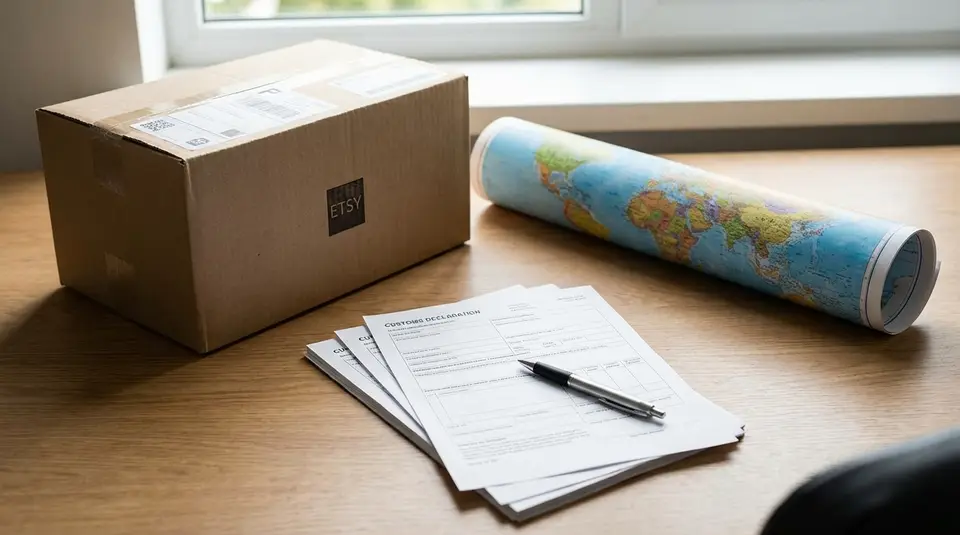
International shipping on Etsy can feel confusing when you first meet things like customs forms, HS codes, and declared values. As soon as you send an order across borders, you’re working with postal rules, import taxes, and customs inspections that affect how quickly your buyer gets their package and how much they’ll pay on delivery.

In this guide, you’ll learn how Etsy shipping labels, customs forms, and accurate item descriptions work together so your parcels clear customs smoothly. We’ll walk through what information you must include, how Etsy pre-fills data for you, when tariff or HS codes are required, and how to avoid delays, returns, or surprise fees when handling international shipping on Etsy.

What customs forms do you actually need when shipping on Etsy?

When customs forms are required (and when they’re not)

On Etsy, you only need customs forms when a package crosses a border. If you are in the US and shipping to a US address, including territories like Puerto Rico that USPS treats as domestic for many services, you normally do not need a customs form. Those labels are simple postage labels with no customs data attached.

Customs forms are required when:

  • You ship from one country to another (for example, US to UK, Canada, EU, Australia, etc.).
  • You use an international service through Etsy shipping labels or Global Postal Shipping.

When you buy an international label on Etsy, the system prompts you to fill in customs details before you can purchase. If you do not see a “Customs” section at all, you are almost certainly buying a domestic label and no separate customs form is needed.

The difference between domestic and international Etsy labels

Domestic Etsy labels (for example, USPS within the US) only need:

  • Sender and recipient addresses
  • Package weight and size
  • Chosen mail class

There is no declared value printed for customs, no tariff codes, and no CN22 or CN23 attached.

International Etsy labels include all of that plus customs data: item descriptions, quantities, values, country of origin, and sometimes tariff / HS codes. Etsy has recently updated these labels so that international labels and customs forms print as either a one‑page or three‑page set, depending on mail class and destination, but they are still generated together as one document when you check out.

So in practice:

  • Domestic label = postage only.
  • International label = postage + customs information in one combined file.

CN22 vs CN23 and other common customs documents

When you hear people talk about “CN22” and “CN23,” they are talking about standard postal customs forms used worldwide:

  • CN22 is the small, usually green or white customs declaration for lower‑value, lighter parcels.
  • CN23 is a larger, more detailed customs declaration used for higher‑value or heavier shipments and often prints as a multi‑page form that goes in a clear pouch.

Etsy does not usually make you choose between CN22 and CN23 yourself. When you purchase an international label, Etsy and the carrier decide which format is needed based on the service, destination, and value, then generate the correct one for you. You will see either a single‑page customs label or a three‑page set to print and attach.

In addition to CN22/CN23, some shipments may also require:

  • An export reference such as an AES/ITN number for high‑value US exports (typically at or above 2,500 USD).
  • Extra commercial invoices for certain couriers or destinations, which your carrier will specify.

For most everyday Etsy parcels, though, the automatically generated CN22 or CN23 that comes with your Etsy international label is the only customs document you will actually handle.

How Etsy shipping labels handle customs forms for you

When the Etsy label doubles as your customs form

For most international orders where you buy the shipping label directly through Etsy (for example, USPS international or Global Postal Shipping), the label you print already includes the customs form. You do not need to fill out a separate CN22 or CN23 at the post office.

When you purchase the label, Etsy asks for item descriptions, quantities, values, weights, and sometimes tariff numbers and country of origin. That information is printed in the customs section of the label, which border agencies scan and read just like a traditional paper form.

You are still responsible for making sure everything is accurate, but the actual “form” part is built into the label layout. Depending on the mail class and destination, it may print as a single page or as a multi‑page set that you place in a clear pouch on the outside of the package.

Using Global Postal Shipping labels and customs info

If you are in the US and choose a Global Postal Shipping label, you print a USPS label addressed to an Asendia processing center. That label covers the domestic leg only. When the package reaches the center, Asendia adds the final international label plus all required customs information and sends it on to your buyer.

From your side, you still enter the customs details during label purchase in Etsy. Those details are passed electronically to the shipping partner, so you do not have to attach an extra customs form yourself. Etsy also generates a customs ID that can be used for tracking once the parcel leaves the US.

When you need to fill out separate postal or courier forms

There are a few situations where the Etsy label will not fully handle customs for you:

  • You buy postage outside Etsy. If you use a carrier’s own website, a local post office, or a courier account, you will follow that provider’s customs process and may need to complete CN22/CN23 or a commercial invoice separately.
  • Your service or destination has extra paperwork rules. Some carriers and countries require additional export documents or special declarations that go beyond what prints on an Etsy label. In those cases, you must check the carrier’s guidance and add whatever they ask for.

As a simple rule: if you bought the international label on Etsy and the carrier does not say otherwise, the printed label already acts as your customs form. If you bought postage anywhere else, assume you need to handle customs forms yourself.

Step‑by‑step: how to fill out Etsy customs forms correctly

Where to find the customs form section in your Etsy order

When you buy a shipping label for an international order on Etsy, the customs form is built into the label flow. After you click “Get shipping labels” for that order, you will see a section labeled something like Customs information or Customs form before you can pay.

If you are in Shop Manager, open Orders & Shipping, click the specific order, then choose Create shipping label. Scroll down the label setup page until you see fields for item description, quantity, value, HS code, country of origin, and similar details. That whole block is your Etsy customs form.

If you are not using Etsy labels and ship through a carrier directly, you will not see this section. In that case, you must fill out the carrier’s own online customs form or a paper CN22/CN23 at the post office.

Writing clear item descriptions that customs will understand

Customs officers are not your customers, so skip cute names and branding. Use plain, factual descriptions:

  • Bad: “Moonlight Magic Trinket”
  • Good: “Silver‑plated brass necklace with glass pendant”

Include:

  • What the item is (mug, T‑shirt, candle, print)
  • What it is made of (ceramic, cotton, soy wax, paper)
  • How it is used (home decor, clothing, jewelry, art print)

Avoid vague words like “gift,” “accessory,” or “craft” as the only description. The clearer you are, the less likely customs is to hold the parcel for extra checks.

Entering quantity, weight, and total item value

For each line item on the Etsy customs form:

  • Quantity is how many units of that product are in the parcel. If the buyer ordered 3 of the same sticker sheet, enter 3.
  • Weight should match your packed item weight as closely as you can. If Etsy pulls in the weight from your listing, double‑check it against your actual package.
  • Item value is the actual price the buyer paid for that item, before shipping but after any discounts. If they used a coupon, use the discounted price, not your usual list price.

Etsy will usually total all item values for you and show a total customs value. Make sure this matches your order total for merchandise. If you add freebies, you can list them as “promotional item – value $0.00” so customs sees why they are in the box.

Choosing the right “gift / merchandise / sample” option

Most Etsy orders should be marked as “Merchandise” because the buyer paid for goods. This is the correct choice for normal sales, even if the order is for a birthday or holiday present.

Use the other options only when they truly apply:

  • Gift: You are genuinely sending a personal gift, not a sale. For example, you mail a handmade scarf to a friend abroad and there is no Etsy order.
  • Sample: The parcel contains product samples for a potential wholesale buyer, press, or collaborator, usually low value and not for resale.
  • Documents (if shown): For paper items like contracts or letters, not typical Etsy products.

Marking a paid Etsy order as a “gift” to help the buyer avoid customs fees can cause delays, fines, or returned parcels. Choose the option that honestly matches the shipment, and your customs forms will work much more smoothly.

What to put for HS tariff code and country of origin

What is an HS or tariff code in simple terms?

An HS or tariff code is just a numeric label that tells customs “what is inside this package.”

HS stands for Harmonized System, a global list of product categories managed by the World Customs Organization. Almost every country uses it to decide:

  • what kind of item you are shipping, and
  • what taxes or duties might apply.

The code is usually 6–10 digits long.

  • The first 6 digits are the international HS code.
  • Extra digits (up to 8 or 10) are added by some countries for more detail.

On Etsy customs forms, this number is often called HS code, tariff code, or tariff no. It does not need to be perfect legalese; it just needs to correctly match the type of product you are sending.


Easy ways to look up the correct code for your product

You do not have to memorize codes. You just need to look them up once per product type, then reuse them. Helpful options include:

  • Official tariff search tools from your own country or your buyer’s country (for US sellers, the Harmonized Tariff Schedule and Census Bureau search tools are common).
  • The EU and UK online tariff databases if you ship a lot to Europe or the UK.
  • Classification tools from your shipping software or postal provider, which often let you type a description like “gold necklace” or “cotton T‑shirt” and suggest a code.

A simple workflow that works well for Etsy sellers:

  1. Write a clear description of the item (for example: “silver stud earrings, sterling silver”).
  2. Use a tariff search tool and paste that description.
  3. Compare a few suggested codes and pick the one that best matches your material and use.
  4. Save that HS code in your product notes or shipping profile so you can reuse it.

How specific your code needs to be for Etsy shipments

For most Etsy parcels, customs are happy if you use a correct 6‑digit HS code that clearly matches the product category. That 6‑digit level is recognized worldwide and is the minimum required for shipments into the EU.

If your destination country uses 8‑ or 10‑digit codes, you can go more specific, but you usually do not have to for small, low‑risk Etsy orders. The key is:

  • The code must match the actual item (for example, “ceramic mug” vs “glass bottle”).
  • The code should be consistent for the same product every time.

If you are unsure between two similar codes, choose the one that best fits the main material and use of the item, and keep that choice consistent across your listings. For high‑value or borderline items, it is wise to ask a customs broker or tax professional.


Picking the correct country of origin for handmade and vintage

On Etsy customs forms, country of origin means “where this product was made,” not where it is being shipped from.

For Etsy sellers, a simple way to think about it:

  • Handmade items

  • If you design and physically make the item in the United States using a mix of local and imported materials, the country of origin is usually United States, because the main manufacturing happens there.

  • If you outsource production to another country (for example, a print shop in Mexico that prints and ships your design), the origin is typically Mexico, even if you live in the US.

  • Vintage items

  • Use the country where the item was originally manufactured, if you know it (often printed on the label, stamp, or packaging).

  • If you genuinely cannot tell, use your best documented information and keep a note for yourself in case customs ever asks.

The important part is to be honest and consistent. Do not pick a country just because you think it will reduce duties. Customs authorities can check labels, invoices, and even product markings, and incorrect origin information can lead to delays, fines, or returned parcels.

Declared value, insurance, and why accuracy really matters

What “declared value” actually means on Etsy customs forms

On Etsy customs forms, the declared value is the true total value of the goods inside the parcel. In most countries, this is the price the buyer actually paid for the items, not including shipping, unless the destination’s rules say otherwise.

Customs uses this number to decide:

  • whether import taxes or duties are owed
  • how much those fees should be
  • whether the shipment is allowed under value limits for certain services

Think of it as you saying to customs: “If this box disappeared today, this is what the contents are worth in money.” That is why it must match your order details and any invoice you include.

How Etsy calculates item value on labels you buy through Etsy

When you buy a shipping label through Etsy for an international order, Etsy usually pulls the item value directly from the order. It adds up:

  • the price of each item in the parcel
  • minus any discounts applied to those items

Shipping and tax are normally not counted as item value, but they still appear elsewhere on the label or receipt. If you only ship part of an order, you can usually adjust the value to match what is actually in that package. Always double‑check the auto‑filled numbers before you buy the label.

Under‑declaring value vs. listing the real price

It can be tempting to lower the declared value to “help” a buyer avoid customs fees, but that creates real risks:

  • Customs can seize, return, or destroy parcels if they suspect false values.
  • Fines or penalties can be issued in some countries for mis‑declaration.
  • You may not be able to prove the real value if something goes wrong.

Listing the real price keeps your records consistent with your Etsy order, payment history, and any invoice. If a buyer asks you to mark a lower value or call a sale item a “gift,” it is safer to politely decline and explain that customs rules require accurate information.

How declared value connects to insurance and claims

Declared value also matters for insurance and loss claims. Many postal services and couriers use the declared value as the maximum they will pay if a parcel is lost or damaged, especially when you purchase extra coverage.

If you under‑declare and the package is lost, any payout may be limited to that lower amount, even if the buyer paid more. On the other hand, if you declare the correct value and keep proof of payment and shipment, you have a much stronger case when you:

  • file a claim with the carrier or insurer
  • refund or partially refund the buyer
  • need to show that you followed customs rules

In short, accurate declared values protect you, your buyer, and your business. It might mean slightly higher import fees for the customer, but it greatly reduces the chance of serious customs problems or painful financial losses later.

DDP vs DAP/DDU: who pays customs fees on Etsy orders?

What it means when buyers pay customs on delivery

When you ship with DAP/DDU (Delivered At Place / Delivered Duty Unpaid), your buyer pays customs fees when the parcel reaches their country. That usually means the carrier or postal service holds the package until the buyer pays any duties, import taxes, and handling fees.

On Etsy, this is still the default in many situations: the seller ships the order, and if the destination country charges import fees, the buyer is treated as the importer and must pay those charges before the parcel is released. Etsy’s own guidance explains that buyers are generally responsible for customs fees on international orders, unless duties are collected upfront.

In practice, this can lead to surprises. The buyer thinks they are “all paid up” at checkout, then gets a text or card from the carrier asking for extra money. If they refuse to pay, the parcel may be returned or even abandoned. Recent changes like the end of the U.S. de minimis threshold mean more parcels can be charged duty, even at low values, so this scenario is becoming more common.

What Delivered Duty Paid looks like in real life for Etsy sellers

With DDP (Delivered Duty Paid), you or your shipping partner pay the import duties and taxes on behalf of the buyer. The buyer sees a higher, more “all‑in” price at checkout, but there are no surprise customs bills at the door.

In a DDP setup for Etsy orders:

  • You choose a carrier or service that explicitly offers DDP for parcels into the destination country.
  • The carrier uses your customs data to calculate duties and VAT, then charges those amounts back to you (often built into your label price or invoiced later).
  • The parcel clears customs as if everything is prepaid, so delivery is usually smoother and faster.

Etsy’s own seller guidance now actively encourages DDP where tariffs are expected, because it reduces refusals, delays, and angry “I had to pay extra!” messages. Some postal DDU options into the US have even been suspended, pushing sellers toward DDP‑style solutions with couriers instead.

For you as a seller, DDP means:

  • You build estimated duties into your item price or shipping fee.
  • Your margin has to cover those extra costs.
  • In return, you usually get happier buyers and fewer delivery problems.

How to explain customs and import fees to your customers

A little clear wording goes a long way. You do not need to teach your buyers trade law; you just need to set expectations. Here is a simple approach you can adapt for your Etsy shop:

  1. In your shop policies and FAQ, explain who pays what.
  • If you ship DAP/DDU most of the time, say something like:

“International buyers are responsible for any customs duties, import taxes, or handling fees charged by their country. These are not included in my item or shipping prices.”

  • If you use DDP for certain destinations, clarify that too:

“For some countries I ship Delivered Duty Paid (DDP), which means duties and import taxes are included in the total you pay at checkout.”

  1. Mention it briefly in your listings. Add one short, consistent sentence near the shipping section, especially on higher‑value items that are more likely to be taxed.

  2. Reassure buyers about what they’ll actually experience.

  • For DAP/DDU: explain that their local postal service or courier may contact them for payment before delivery.
  • For DDP: highlight that the price they see is the total, with no extra customs bill on arrival.
  1. Answer messages in plain, friendly language. If a buyer asks, you can reply with something like:

“Because this is an international order, your country may charge customs or import fees. If that happens, your postal service or courier will contact you to collect them. I do not control these charges, and they are not paid through Etsy at checkout.”

Being upfront about DDP vs DAP/DDU keeps expectations realistic, protects your reviews, and makes your Etsy shop feel professional and trustworthy.

Avoiding delays: common customs mistakes Etsy sellers make

Vague or “cute” item descriptions that confuse customs

Customs officers do not share our love of “mystery boxes” and “happy mail.” They need to know exactly what is in the parcel. Vague descriptions like “gift,” “craft supplies,” “clothes,” “accessories,” or “online order” are now a big red flag in both the US and many other countries, and can trigger holds or rejections.

On your Etsy customs form, describe each item in plain, specific language. A good description usually answers: what it is, what it is made of, and what it is used for. For example:

  • “Men’s cotton T‑shirt” instead of “clothing”
  • “Soy wax scented candle in glass jar” instead of “home decor”

If your product has variations, you do not need a novel, but a little extra detail helps customs match your HS code and keep the parcel moving.

Forgetting tariff codes or required details for the EU and US

For many destinations, missing or wrong HS / tariff codes is no longer a small mistake. The EU requires at least a 6‑digit HS code on incoming parcels, and packages without one can be delayed or returned.

The US and other North American authorities are also tightening rules. Carriers are being told to reject manifests that do not include a valid 6‑digit HS code and a matching, clear description.

Common slip‑ups include:

  • Leaving the HS code field blank “because it’s just a small order”
  • Copy‑pasting the same code for every product, even when they are very different
  • Using a code that does not match the written description

On Etsy, take the time to add correct HS codes and full descriptions in your shipping settings or per order. It feels fussy once, but it saves you from repeated customs problems later.

Mixing personal gifts and Etsy orders in the same parcel

Putting a sold Etsy order and a personal gift to the same person in one box sounds kind and efficient, but it can confuse customs. Many countries treat “gifts between private individuals” differently from commercial shipments. If your parcel contains both, officers may:

  • Reclassify the whole thing as a commercial shipment
  • Ignore any “gift” exemption that might have reduced fees
  • Question the declared value if it does not match the invoice inside

To avoid this, keep Etsy orders and true personal gifts in separate parcels with their own customs forms. If you must combine them, declare everything as merchandise, list each item clearly, and be ready for the buyer to pay normal import charges.

How packaging and invoices can help speed clearance

Good packaging does more than protect your product. It also helps customs see that your shipment is legitimate and correctly declared. A few simple habits make a big difference:

  • Place the customs form and any commercial invoice on the outside of the box in a clear pouch so barcodes and text can be scanned without opening the parcel.
  • Make sure the description, HS code, quantity, and value on the form match what is on the invoice and in the parcel. Mismatches are a common reason for extra checks.
  • Avoid stuffing multiple unrelated orders for different buyers into one box unless you are using a service that is designed for consolidation and properly documents each shipment.

Neat, consistent paperwork plus sturdy, tidy packaging sends a quiet signal to customs: “This shipment is low risk and well documented.” That is exactly the kind of parcel they like to clear quickly.

Country‑specific quirks Etsy sellers should watch for

Extra rules when shipping to the EU and UK

When you ship Etsy orders into the EU, customs will look very closely at VAT and electronic data. For low‑value parcels up to 150 EUR coming from outside the EU, marketplaces like Etsy are usually treated as the “deemed supplier,” which means Etsy collects VAT at checkout and passes it on. Your job is to make sure your carrier sends Etsy’s IOSS number and VAT details electronically with the customs data, not printed on the box. If that data is missing or wrong, EU posts often charge the buyer VAT again plus a handling fee, or they simply return the parcel.

Above 150 EUR, import VAT and any customs duty are normally collected on arrival, and buyers may see brokerage or “presentation to customs” fees. Some EU countries are stricter than others about tariff codes and item descriptions, so vague labels like “gift” or “craft supplies” can trigger delays.

The UK has its own twist. For goods shipped from outside the UK with a consignment value of 135 GBP or less, Etsy usually collects UK VAT at checkout and is responsible for paying it to HMRC. You still need to mark the parcel correctly so customs can see that marketplace VAT was collected; if the data is missing, the buyer may be charged VAT again plus Royal Mail or courier fees. For consignments over 135 GBP, normal import VAT and customs duty rules apply, and the buyer typically pays on delivery.

Things to know when shipping to the US after rule changes

The United States used to allow most packages under 800 USD to enter duty‑free under the “de minimis” rule. That has now changed. In 2025, the U.S. government ended the broad de minimis exemption and introduced new tariffs on low‑value imports, including many direct‑to‑consumer ecommerce parcels. Most international Etsy orders going into the U.S. can now be charged country‑specific duties or flat fees, often in the 80 to 200 USD range per shipment, depending on how the carrier processes the parcel.

For you as a seller, this means:

  • U.S. buyers are more likely to face customs charges even on small orders.
  • Carriers may ask for more detailed HS codes and item descriptions to classify goods correctly.
  • Some foreign postal services and couriers have temporarily limited or paused shipments to the U.S. while they adapt, which can cause sudden service changes or long delays.

If you ship to U.S. customers from abroad, it is smart to: clearly warn buyers that extra import fees may apply, keep your customs data very accurate, and choose carriers that have updated their systems for the new rules.

Some countries are simply “fee‑happy.” Even when Etsy or another marketplace collects VAT, local postal operators may still charge:

  • a small “customs handling” or “presentation” fee just for processing the parcel
  • storage fees if the buyer takes several days to pay the charges
  • extra brokerage fees when express couriers are used instead of the postal service

This is especially common in parts of the EU, the UK, and now the U.S. after the de minimis changes. Buyers may not see these local fees at checkout, so it helps to add a short note in your Etsy shipping policies explaining that customs, VAT, and local handling charges are the buyer’s responsibility unless you clearly say otherwise.

A little upfront explanation goes a long way: it reduces unhappy messages, protects your reviews, and helps your lovely handmade items glide through customs instead of sitting in a warehouse.

Printing, attaching, and tracking your customs documents

Where each page of a multi‑page customs form should go

When you ship internationally, some services still generate multi‑page customs forms. A common setup is: one copy for the destination country’s customs, one for the origin post office, and sometimes one for the carrier’s internal use. The pages are usually labeled clearly, so always follow the wording on the bottom or top of each sheet.

As a simple rule:

  • The top copy (often marked “Customs” or “Destination”) goes on the outside of the parcel.
  • Any copy marked “Sender’s copy” or “Archive” is for your records.
  • If your carrier asks for a “Post Office” or “Acceptance” copy, hand that one over when you drop off the package.

Do not tape all the pages flat across the box. They should be stacked together, folded neatly, and placed where staff can remove or scan them without ripping your packaging apart.

Using clear pouches and making forms scannable

Most postal and courier services prefer customs forms in a clear plastic pouch on the outside of the parcel. If you do not have branded pouches, you can use a generic clear sleeve and tape all four edges securely, leaving the opening facing away from seams and corners.

Place the pouch on the same side as the shipping label, usually the largest flat surface. Avoid covering barcodes, QR codes, or important text with tape or stickers. If your form has a barcode or 2D code, make sure it sits flat, not over a fold or edge, so scanners can read it quickly.

If you are handwriting anything, use dark ink and print clearly in block letters. Faded ink, cursive, or writing over seams can cause delays because customs officers and machines cannot read the details easily.

Finding and sharing your customs ID or tracking number with buyers

Once your Etsy label is purchased, you will usually see a tracking number in the order details. For many international services, that tracking number also acts as the main customs reference that carriers and customs systems use.

You can:

  • Copy the tracking number from your order page and paste it into your message to the buyer.
  • Encourage buyers to use Etsy’s built‑in tracking view so they see the same scans you do.
  • Mention that any customs or import updates will usually appear under that same tracking link.

If your carrier provides a separate customs reference or shipment ID, add it to your order notes and share it in a short, friendly message. Let the buyer know that this is the number their local post or customs office might ask for if there is a delay. Clear tracking info reassures buyers and saves you both a lot of back‑and‑forth later.

What to do if a customs issue comes up

If a parcel is held, returned, or destroyed by customs

When customs holds a parcel, stay calm and start gathering information. Check the tracking first. If you see messages like “Held in customs,” “Awaiting clearance,” or “Customs retention,” take a screenshot and note the date. Then contact the carrier with the tracking number and ask what is missing: invoice, ID number, tariff code, or proof of value.

If they need documents, send a clear copy of the order details, invoice, and any customs form you used. Share these with your buyer too, so they know what is happening and can help if their local customs office contacts them.

If a parcel is returned, inspect the package and any stickers or notes from customs. They often show the reason, such as “insufficient description” or “prohibited item.” Refund or resend according to your shop policies, and explain to the buyer what went wrong and what you will change next time.

If customs destroys a parcel (usually for prohibited or restricted items), you normally will not get it back. Show the buyer any proof you receive from the carrier, follow your policies, and then update your listings so you do not ship that type of item to that country again.

How to respond when a buyer is charged unexpected fees

When a buyer is hit with surprise customs or import fees, start with empathy. Thank them for letting you know, acknowledge that the fees are frustrating, and ask for a photo or receipt of the charges so you understand exactly what they paid.

Next, check what you stated in your listing and shipping profile about customs and import taxes. If you clearly said that buyers are responsible for these fees and you shipped DAP/DDU (buyer pays on delivery), kindly remind them of that note and explain that the charges come from their country’s customs, not from Etsy or you.

If your wording was vague or missing, consider offering a partial refund or store credit as a goodwill gesture, especially for a first‑time issue. Whatever you decide, keep your tone friendly and factual, and avoid promising that future orders will be “fee‑free,” because customs rules can change at any time.

Updating your listings and shipping profiles to prevent repeats

Every customs problem is a little lesson for your shop. After an issue, review the affected listing and your shipping profiles. Add a short, clear line about customs, such as who pays import taxes, possible delays, and any countries you do not ship certain items to.

If a specific destination often adds high fees, mention that in the listing so buyers can decide before they order. For items that have stricter rules (like food, cosmetics, wood, or seeds), add a note about any countries you cannot ship to and consider blocking those locations in your shipping settings.

Finally, keep a simple internal checklist for international orders: correct customs form, clear description, HS code if needed, and realistic value. Updating your listings and shipping profiles after each incident turns one bad experience into smoother, more predictable shipping in the future.

Related posts

Keep reading