
How to Add Credentials and Experience to Etsy Listings (Without Overclaiming)

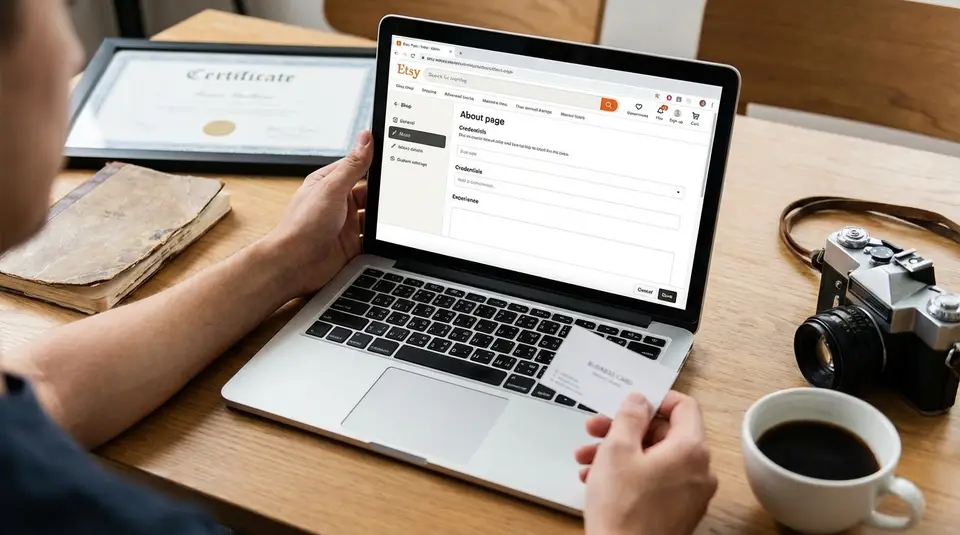
Etsy listings feel far more trustworthy when your expertise is shown through clear, verifiable details instead of big claims. Mention credentials only where they directly relate to what the buyer is purchasing, like a relevant license for a service, a completed course tied to your technique, or years working in that exact craft, then pair it with specifics such as materials, dimensions, process steps, and who makes what. Keep wording tight and literal: say what you did, what you use, and what you can document, and avoid implying official approval, guaranteed results, or “certified” status unless it truly applies. A common credibility killer is mixing personal background into product promises without drawing that line.
Credibility signals you can add inside an Etsy listing
Credentials, training, and memberships
The most persuasive credentials in an Etsy listing are the ones that are tightly tied to the item. Think: a relevant license for a regulated service, a course focused on your technique, or an association membership that matches the craft. Keep it specific and plain.
Good credential phrasing usually includes (1) what it is, (2) who issued it, and (3) how it relates to what the buyer will receive. If you cannot verify it, or it is only loosely connected, skip it. Buyers can sense when a credential is being used as a shortcut for quality.
Also, be careful with words like “certified.” Use it only when you are genuinely certified by a recognized program, and only for the scope that certification covers.
Process details and quality standards
On Etsy, credibility often comes through process. A few concrete details can do more than a paragraph of claims. Add the steps that matter to quality, such as how you size, finish, seal, test fit, or package the item.
Useful signals include your material specs, measurement method, equipment used (if it matters), and any quality checks you repeat every time. If there is variation because it is handmade, say what can vary and what you control. This reads professional and reduces “item not as described” surprises.
If you sell in categories where buyers might assume health benefits, keep claims conservative and aligned with Etsy’s rules on medical claims.
Reviews that mention expertise
You cannot write your own reviews, but you can structure the listing so buyers notice the reviews that already prove skill. In your description, point readers toward what to look for, like “check reviews for notes on fit, finish, and packaging,” rather than quoting or cherry-picking a single line.
If you respond to reviews, keep it short, factual, and customer-focused. Remember that Etsy’s review tools and time windows matter, and a public reply can limit further edits. Etsy explains the basics in How the Review System Works for Sellers.
Where to place credentials in Etsy listing fields
Title and photo text rules
Your Etsy title is prime real estate, so keep credentials there only if they change how a buyer understands the item. Good examples are short, factual add-ons like “licensed electrician” for a permitted service, or “GIA-trained” for certain jewelry work, if it’s accurate and relevant. Etsy’s current guidance is to lead with what the item is and keep titles clear and scannable, often under 15 words, so a long credential list can hurt readability even if it’s true. New Guidance for Listing Titles is a good north star here.
For listing photos, prioritize clarity over badges. Text-heavy overlays can look spammy, and they can distract from what’s actually being sold. If you do add any on-image text, keep it minimal and factual (for example, “Sterling silver, hand-finished”), and make sure the photo still accurately represents the item.
A cleaner option is to put credibility in the image details instead: use close-ups, process shots, and packaging shots. Also consider adding alt text that describes what’s shown (materials, finish, scale). It helps accessibility and can support off-Etsy SEO.
Description placement that reads naturally
In the description, place credentials where they answer a buyer’s question. Usually that’s near your “what it is / what you get” paragraph, or right before your process details.
A simple pattern works well: one sentence of qualification, then proof of practice. Example: “Made by a trained metalsmith. Each ring is soldered, filed, and polished by hand, then checked for smooth edges and consistent sizing.”
Avoid tying credentials to guaranteed outcomes. Keep it about your method, not a promise.
Variations and personalization fields
Use variations for objective options (size, finish, add-on hardware). Use personalization to collect buyer inputs (names, dates, short text, sizing notes). This is also a smart place to reinforce professionalism with clear instructions, like “Enter text exactly as you want it engraved (case-sensitive),” or “If you’re between sizes, leave your wrist measurement in inches.”
If a credential matters only for certain options, reflect it there. For example, a “hand-stamped” upgrade can include a short note about tools used or standards you follow, without bloating the main title.
Writing experience statements that are specific and verifiable
Years, volume, and specialty without exaggeration
The easiest way to sound credible on Etsy is to be concrete. Instead of “expert” or “master,” use specifics you can stand behind: how long you’ve practiced the craft, what you make most often, and what you’ve learned to prioritize.
Strong, verifiable experience statements look like:
- “Making leather wallets since 2016, with a focus on saddle stitching and edge finishing.”
- “I’ve made 300+ engraved pet tags. I specialize in deep stamping for long-term legibility.”
- “Trained in lampworking basics and now focused on small-batch glass beads in neutral palettes.”
If you cite numbers, keep them believable and easy to defend. If you are estimating, you can say “approximately” or “around.” That honesty reads confident, not weak. Also, keep the scope tight. You don’t need to be “experienced in everything,” you need to be experienced in this exact item.
Before and after claims for handmade upgrades
“Before and after” works best when it describes the product, not a life outcome. Focus on what changes physically when a buyer chooses an upgrade.
Examples:
- Before: “Standard hardware.” After: “Upgraded stainless steel jump rings for better corrosion resistance.”
- Before: “Basic sanding.” After: “Sanded through higher grits and finished with a protective topcoat for a smoother feel.”
- Before: “Name label.” After: “Heat-set vinyl label with a cleaner edge and stronger adhesion.”
Avoid guarantees like “will last forever,” “won’t fade,” or “heals pain.” If durability varies by use, say so.
Linking to proof without spamming
You don’t need a wall of links to prove credibility. One simple proof point is enough when it’s relevant: a photo of your tools in use, a short process video, or a clear materials close-up.
If you mention a credential, you can also show it without overdoing it, like a cropped photo of a certificate (with personal details removed) or a short line in your shop’s About section. Keep the listing focused on what the buyer gets, and treat proof as supporting detail, not the headline.
What Etsy policies allow for expertise, licensing, and claims
Avoiding medical, legal, and guaranteed outcome claims
On Etsy, it’s fine to explain your background and your process. The risk starts when “experience” turns into a promise.
Keep your claims tied to the product, not the buyer’s body, finances, immigration status, court case, or any other outcome you can’t control. Avoid language that implies treatment, diagnosis, prevention, or cure. Etsy has a specific Medical Claims policy that covers both disease claims (like “treats arthritis”) and structure/function claims (like “changes hormones” or “improves circulation”).
The same general rule applies to legal-style claims. Don’t imply you’re giving legal advice, that your template “guarantees compliance,” or that your service replaces a licensed professional. If you do have a license, state it factually and keep the scope clear.
Also skip guarantees. You can describe durability-focused choices (“sealed,” “double-stitched,” “UV-resistant pigment”), but “won’t ever break” is the kind of absolute statement that backfires in disputes and reviews.
Using trademarks, brands, and certifications correctly
Use brand names only when they’re necessary and accurate, like describing compatible parts, authentic materials, or an official component you’re reselling with the right to do so. Avoid using brand names to imply affiliation or “official” status if you don’t have it. If you’re unsure, it helps to understand what a trademark is and why certain wording triggers complaints.
For certifications, name the exact credential and issuer. Don’t imply a broader certification than you actually have, and don’t use “certified” as a vibe word.
Common red-flag phrases to rewrite
- “FDA approved” → “Made with cosmetic-grade ingredients” (only if true)
- “Cures anxiety / depression” → “Scent profile: lavender and chamomile”
- “Guaranteed results” → “Designed to support…” or “Many buyers use this for…” (without health claims)
- “Legal in all states / compliant” → “Digital template. Not legal advice. Check your local requirements.”
- “Official / authorized / licensed” → “Compatible with…” or “Made to fit…” (if you’re not officially affiliated)
Photos and listing visuals that reinforce professionalism
Process photos and behind-the-scenes credibility
If you want buyers to feel your expertise, show it. A single process photo can do more than a paragraph about “high quality.” Focus on moments that signal skill and consistency: measuring, cutting, finishing, engraving, sewing, glazing, or final inspection.
The key is to make the process readable. Use clean backgrounds, good light, and tight framing. Include the tools that matter (a burnisher, calipers, kiln shelves, polishing setup) without turning the photo into a gear flex. If you offer custom work, consider one short photo sequence that shows the stages from blank to finished. Buyers often trust what they can visualize.
For digital products, behind-the-scenes can still work. Show a screenshot of your editable file layers, a preview of the included pages, or a clip of how the template is used, as long as it stays clear what the customer is receiving.
Packaging, materials, and sizing proof images
Professional listings answer the “What exactly am I getting?” questions before they’re asked. Add photos that verify:
- Materials: close-ups of texture, weave, grain, or finish; labels only if they’re relevant and truthful.
- Scale: the item next to a ruler, coin, hand, or common object. For jewelry, include on-body shots plus a measurement photo.
- Fit and compatibility: if it’s made to fit something specific, show it fitting that thing (or a clearly labeled model).
- Packaging: what arrives in the mail, how it’s protected, and any gift-ready options.
These images reduce returns and “smaller than expected” reviews. They also make your experience claims feel grounded because buyers can see the standards you work to.
Graphic badges and when to skip them
Badges like “Handmade,” “Premium,” “Professional,” or “Certified” can help, but they’re easy to overdo. If a badge repeats what Etsy already shows (like “Handmade”), it often adds visual noise without adding trust.
Use a badge only when it communicates a specific, verifiable detail that’s hard to show in a photo, like “Solid 925 sterling silver” or “Made to order in 3 to 5 business days.” Skip badges that sound like guarantees (“Lifetime quality,” “No fade ever”) or that imply approvals you don’t have (“FDA,” “official,” “authorized”).
When in doubt, replace the badge with a proof photo: a crisp materials close-up, a sizing chart image, or a packaging shot. Proof almost always beats a label.
Listing attributes and personalization that build buyer confidence
Choosing attributes that match your real process
Listing attributes are more than search filters. They’re a promise to the buyer about what they’ll receive. Add every attribute that truly applies, and leave the rest blank. Selecting “close enough” attributes can bring the wrong shoppers to your listing, and that usually ends in low conversion or disappointed reviews.
A good rule: if you would not feel comfortable seeing that attribute on the packing slip, don’t select it. Materials, finishes, style tags, size ranges, and occasion are especially important because buyers use them to compare similar items quickly. Etsy also notes that irrelevant attributes can create a disappointing shopping experience, so it’s worth treating attributes like a quality control step, not a checkbox. Add Attributes to Help Increase Your Shop's Visibility
Sustainability attributes and documentation
Sustainability attributes can build trust fast, but only when you can back them up. If you mark a listing as recycled, organic, responsibly sourced, or low-impact, make sure you have supplier info, invoices, or material documentation you could share if a buyer asks.
If you’re using reclaimed materials, be specific about what is reclaimed and what isn’t. “Reclaimed wood top with new steel legs” is clearer than “eco-friendly table.” Clarity protects you from overclaiming and helps the right buyers find you.
Custom requests, lead times, and expectation-setting
Personalization fields and variations are where confidence is won or lost. Use them to prevent mistakes:
- Tell buyers exactly what to enter (spelling, capitalization, dates, sizing format).
- Add a short “we’ll copy exactly what you type” note for engraved or printed items.
- If an option changes production time, reflect that in your processing setup and in one plain sentence in the description.
For lead times, avoid vague promises like “ships fast.” Give a realistic processing window, and explain what can extend it (drying time, made-to-order queues, approval of proofs). When buyers know what to expect, they’re far more forgiving when handmade work takes time.
Related posts
Keep reading

Why Your Etsy Listings Get Views but No Sales
Turn your Etsy views into steady sales with better keywords, pricing, photos, and conversion-focused listing tweaks that build trust and boost shop revenue.
How to Build a Size Guide for Etsy Listings (Examples)
Size guide for Etsy listings with clear measurement tables, photo-ready charts, and examples for apparel and prints to cut buyer sizing questions and returns.

How to Use FAQ Images in Etsy Listings to Reduce Questions
Etsy FAQ images that answer shipping, sizing, and customization upfront, with readable mobile-friendly design, order, and wording tips to cut repeat messages.

How to Set Up SKU Numbers for Etsy Listings (Beginner-Friendly Guide)
Etsy SKU numbers made simple: add them in Inventory and Pricing, set SKUs for variations, and pick a clear 4-8 character system to track stock fast every day.

How to Protect Your Etsy Shop From Scams and Phishing
Etsy phishing scams: spot fake support messages, QR-code traps, and off-platform payment requests, then lock down your account with 2FA and spam reporting.

Etsy Shop Icon Guide: Choosing a Logo That Looks Good at Small Sizes
Etsy shop icon tips for crisp logos: 500x500 sizing, bold shapes, high contrast, safe padding, quick checks for legibility in feeds, receipts, and the app.