
Selling Cosmetics on Etsy: Ingredient List and Net Weight Labeling Basics

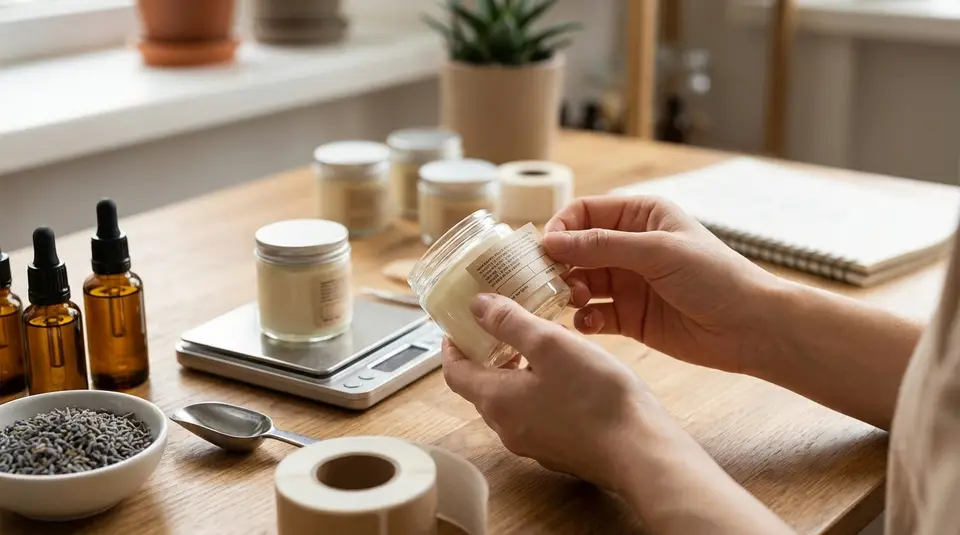
Etsy cosmetic labeling starts with two non-negotiables: a readable ingredient list and an accurate net quantity of contents on the package. The ingredient declaration should use standard cosmetic ingredient names and be listed in descending order by predominance, with the small-amount items and color additives handled the way labeling rules allow. Net weight labeling needs to match what you are selling (weight for balms, butters, and solids; volume for liquids), and it belongs on the principal display panel where a shopper can spot it quickly. One easy-to-miss mistake is mixing up ounces and fluid ounces, which can make an otherwise polished product look untrustworthy.
Is my handmade product a cosmetic under US rules?
Cosmetics vs drugs vs soap
Under U.S. rules, your handmade body product is classified based on intended use, not how “natural” it is or where you sell it. The FDA’s plain-English guide, Is It a Cosmetic, a Drug, or Both? (Or Is It Soap?), is the best starting point.
In general:
- Cosmetics are products meant to cleanse, beautify, promote attractiveness, or alter appearance. Think “moisturizes,” “adds shine,” “cleanses,” or “deodorizes.”
- Drugs are products intended to treat or prevent disease, or affect the structure or function of the body. On Etsy, this is where sellers get into trouble fast, because drug-like claims can make a listing non-compliant even if the formula is gentle.
- Soap has a special, narrower definition under FDA rules. Many handmade “soap” listings are actually cosmetics once you add synthetic detergents or make extra claims beyond cleansing (like “moisturizing” or “deodorizing”).
A practical rule of thumb for Etsy: if your title, tags, photos, or description read like a treatment plan, you are drifting toward drug territory. Etsy also flags certain medical claims and regulated items, so classification is both a legal and a marketplace issue.
Examples common on Etsy
Common cosmetics on Etsy include body butter, facial oil, lip balm (no SPF), sugar scrub, bath salts, perfume oil, beard oil, and lotion bars.
Products that can become drug or drug/cosmetic depending on claims include anti-dandruff shampoo, acne “treatment” serums, eczema relief balm, muscle pain rubs, and anything claiming sun protection (SPF).
If you want Etsy-specific guardrails, Etsy’s Product Safety Essentials: Selling Cosmetics Products lays out how certain claims can push a cosmetic into “drug” territory and risk removal.
US cosmetic labeling rules that apply to Etsy sellers
FDA authority and the FPLA
If you sell cosmetics on Etsy to U.S. buyers, your labels are not just branding. They are regulated information. In the U.S., cosmetic labeling is enforced under the Federal Food, Drug, and Cosmetic Act and the Fair Packaging and Labeling Act, with detailed rules in FDA regulations (including 21 CFR Parts 701 and 740). The FDA’s Summary of Cosmetics Labeling Requirements is a solid checklist-style overview.
For most handmade Etsy cosmetics, the big practical takeaways are:
- Your outer label needs the core consumer info, especially the ingredient declaration and the net quantity of contents on the principal display panel.
- Labels cannot be false or misleading. This includes implied outcomes in product names, before-and-after style marketing, and “medical” language that changes how the product is regulated.
- If you use an outer box or wrapper plus an inner jar, some required statements may need to appear on both containers depending on how the product is sold and presented.
Etsy is also clear that sellers are responsible for compliance and may be asked to provide label details or documentation. Their Product Safety Essentials: Selling Cosmetic Products is worth reading before you finalize your label design and your listing copy.
State rules to watch for
Federal labeling is the baseline, but state rules can add another layer, especially when you ship nationwide on Etsy. A few common patterns to be aware of:
Some states require ingredient or chemical reporting to a state agency for certain cosmetics. Others restrict specific chemicals in cosmetics or packaging, including some PFAS-related restrictions and reporting timelines that affect products sold into that state.
If you sell across the U.S., it’s smart to keep a simple compliance habit: track where you ship, keep your formulas and supplier documentation organized, and review state-specific requirements any time you add a new ingredient, fragrance, pigment, or preservative.
Ingredient list requirements for cosmetic labels and listings
Using INCI names and common names
For U.S. cosmetic labels, the ingredient list needs the common or usual name for each ingredient. In practice, many sellers use INCI-style names because they are widely recognized in cosmetics and align with how suppliers document raw materials. The key is that the name on your label should be understandable and acceptable for U.S. labeling. FDA does not treat non-English terms like “Aqua” or “Parfum” as stand-ins for “Water” or “Fragrance” by themselves, but it generally allows those kinds of terms in parentheses after the English name, which is a helpful compromise for Etsy sellers who also ship internationally. You can review examples and naming expectations on FDA’s page about cosmetic ingredient names.
For Etsy, it’s smart to keep your listing consistent with your label. Buyers often compare the two. If your product has a box plus an inner jar, make sure the ingredient list matches across packaging and what you show in photos.
Ingredient order and the 1% rule
The standard rule is descending order of predominance by weight as the product is formulated. After that, there’s a practical flex point: ingredients present at 1% or less can be listed in any order after the ingredients over 1%. This is why you’ll often see a clear “main base” up front, followed by preservatives, chelators, and similar low-level ingredients grouped near the end.
If you batch small, keep a version-controlled formula sheet. It makes it much easier to update labels when you tweak usage rates, change a supplier, or swap a fragrance.
Color additives and fragrance labeling
Color additives and fragrance get special handling. Fragrance can typically be listed simply as “Fragrance” (or “Flavor” for lip products), rather than disclosing the individual components. Color additives can be listed without strict predominance ordering, and some product types (like “shaded” cosmetics) may use “may contain” style approaches for certain colors. The detailed rules live in 21 CFR 701.3.
On Etsy, color compliance matters even more. Etsy may remove listings that appear to use unapproved color additives, especially for products used around the eyes or on lips. Keep your pigment or mica documentation, and label colorants clearly.
Net quantity of contents labeling for jars, tubes, and bottles
Weight vs volume and when to use each
The “net quantity of contents” is the amount of product in the package, not counting the jar, cap, shrink band, or outer box. For cosmetics, the default rule is simple: liquids use fluid measure and solids, semisolids, and viscous products use weight. This is why a toner is usually labeled in fl oz, while a body butter or balm is labeled in oz (net wt.).
On Etsy, the most common mismatch is a product that is clearly a thick cream or balm but is labeled in fluid ounces. Another frequent issue is writing “oz” when you really mean “fl oz,” which changes the meaning. If your product is scoopable, spreadable, or pourable only when warm, it often belongs in net weight.
US customary and metric units
For U.S. cosmetic labeling, your net quantity statement is typically shown in U.S. customary units (oz for weight, fl oz for volume). Many sellers also add metric (g or mL). Metric is allowed and often appreciated by buyers, but it should be accurate and not used to “round up” the size.
A clear example format looks like this:
- Net Wt. 2 oz (57 g)
- Net Contents 4 fl oz (118 mL)
The regulatory details for how the statement is expressed and formatted are laid out in 21 CFR 701.13.
Placement on the principal display panel
Your net quantity must appear on the principal display panel, meaning the front panel most likely to be seen at retail. It also needs to be easy to spot and separated from other text, usually near the bottom area of that panel.
For Etsy sellers, placement matters for both compliance and customer trust. If buyers can’t quickly find the size in your photos, they tend to ask questions, leave lower reviews, or assume the container is “bigger than it is.” Matching your label net quantity to the size shown in your Etsy listing (title, variations, and description) prevents confusion and helps reduce “not as described” complaints.
Other must-have label elements beyond ingredients and net weight
Product identity statement
Beyond the ingredient list and net quantity, your label needs an identity statement. This is the plain description of what the product is and what it’s for. Think “Body Butter,” “Facial Cleanser,” or “Lip Balm.”
On many Etsy cosmetics, the product name is creative. That’s fine. But the identity statement should still be clear to a first-time buyer. If your front label says “Moon Milk,” add a straightforward identity like “Body Lotion” so the product isn’t confusing or misleading. FDA’s cosmetics labeling rules call this out as a required front-panel element.
Name and place of business
Your package also needs the name and place of business of the manufacturer, packer, or distributor. This typically means business name plus city, state, and ZIP. A street address is usually required, but it may be omitted if it’s listed in a current city or phone directory. If you’re not the manufacturer (for example, you have products made for you), your label should say “Manufactured for” or “Distributed by,” as appropriate.
For Etsy sellers, this is one of the easiest ways to look professional fast. It also gives buyers a clear point of contact if there’s a question about an ingredient or a reaction.
When country of origin is required
If you import finished cosmetics and sell them on Etsy in the U.S., country of origin marking rules can apply. In general, imported goods (or their containers) must be marked with the English name of the country of origin for the ultimate purchaser. Etsy also lists “country of origin” as a common required label element for cosmetics.
If you make the product in the U.S. but use globally sourced ingredients, that does not automatically mean you must list every ingredient’s country. Most handmade sellers only need to think about country of origin when the product itself, or its retail-ready packaging, is imported.
Warnings and directions that matter for cosmetic safety labeling
Common warning examples by product type
Not every cosmetic needs a warning, but some categories do. If you sell these on Etsy, double-check the specific required language before you print labels:
- Aerosols and self-pressurized products (like spray deodorants, hair sprays, dry shampoos): often require flammability and use warnings.
- Feminine deodorant sprays: have their own required caution statements.
- Foaming detergent bath products (classic “bubble bath” style products): often need child-safety related warnings.
- Hair dyes that use certain coal-tar color additives: require a caution statement and directions to do a skin test.
- Suntanning preparations without sunscreen: can require a sun exposure warning.
Etsy also calls out that some cosmetics require warnings and may remove listings that do not comply, especially when products could be misused or marketed in a risky way. The best Etsy-specific starting point is Product Safety Essentials: Selling Cosmetic Products.
When directions are required to prevent misuse
Directions are required when a cosmetic could be hazardous if used the wrong way. Common examples for handmade products include strong exfoliants, products used near the eyes, essential oil blends, and anything meant to be left on the skin for a limited time (like masks or peels). Clear directions should cover the basics: where to apply, how long to leave on, how to rinse, and the most important “do not” points (for example, “for external use only,” “avoid eye area,” “do not use on broken skin”).
Claims that can trigger drug rules
Your label and Etsy listing can turn a cosmetic into a drug based on claims. Red-flag phrases include “treats acne,” “heals eczema,” “anti-fungal,” “reduces inflammation,” “pain relief,” “antibacterial,” and anything implying SPF or sun protection. Even if the formula is gentle, those claims can trigger drug requirements and may violate Etsy policy for prohibited medical claims.
Label placement, font size, and legibility requirements
Principal display panel vs information panel
Cosmetic labels are not “put the text anywhere you can fit it.” U.S. rules split key info across two main areas.
The principal display panel (PDP) is the front-facing panel a shopper sees first. On most jars, tubes, and bottles, the PDP must include your product identity (what it is) and the net quantity of contents. Net contents also has specific placement expectations, including being a distinct statement and typically positioned in the bottom portion of the PDP, with minimum type size that scales up as the PDP area gets larger.
The information panel is where shoppers look for the details. This is where you typically place the ingredient declaration and the name and place of business. Ingredients must be easy to read at purchase time, and the minimum lettering size is usually at least 1/16 inch, with a smaller 1/32 inch option allowed for very small packages (based on total labelable surface area). Warnings, when required, must be prominent and conspicuous, and they have their own minimum type size expectations too.
For Etsy sellers, “legible” also means “legible in your listing photos.” If your label is tiny, add a clear close-up photo of the ingredient list and net contents so buyers can verify what they’re purchasing.
Small packages and tag or insert options
If your container is too small or decorative (like certain compacts, pencils, or mini pots), rules allow alternatives such as a firmly affixed tag, tape, or card for the ingredient list in some situations, and outer packaging (like a box) can carry required details.
The safest approach for Etsy is to assume the buyer may receive only what you ship. If you rely on an outer box, do not ship the product without it. And if you use an insert for directions or warnings, make sure the required label elements still appear where the law expects them on the package itself.
Related posts
Keep reading

Etsy Featured Listings: How to Curate Your Shop Homepage
Etsy featured listings help spotlight bestsellers on your Shop Home; pick 4 (or sections), order them for cohesive photos, and rotate a queued set for seasons.

Selling Jewelry on Etsy: Metal Disclosure and Allergy Considerations
Selling jewelry on Etsy: List exact metals, flag nickel sensitivity, and support hypoallergenic wording with supplier docs or testing to reduce buyer issues.

How to Use Etsy “Materials” and “Occasion” Fields Strategically
Etsy Materials and Occasion fields can boost visibility when chosen for buyer filters; match category, avoid guesswork, and align tags with real intent.

Etsy SEO Tips to Rank Higher in Search
Happy Etsy SEO tips for sellers: master keywords, titles, tags, photos, reviews, free shipping, and conversions to rank higher in Etsy search and boost sales.

How to Create a Line Sheet for Wholesale Buyers (Simple Structure)
Line sheet for wholesale buyers: a simple layout with clear photos, SKUs, sizes, colorways, wholesale/MSRP pricing, MOQs, ordering terms, and contact details.
Selling Resin Items on Etsy: Safety Notes and Handling Instructions
Selling resin items on Etsy? Add clear care cards: full cure time, ventilation notes, heat/UV limits, allergy and choking warnings, plus safe cleaning tips.